Due to the company’s development policy, we hold a large number of state-of-the-art pieces of equipment and facilities, able to carry out national-level environmental works.
Area deposit for temporary storage, hazardous waste management through mechanical, chemical, and biological methods,
According to the Integrated Environmental Authorization no. 117 NV6 of October 18, 2010:
- commissioned in 2009, featuring a storage capacity of 200,000 t;
- waste can be stored in bulk or packed;
- holds concreted platforms with gutters for leachate takeover;
- the platforms are used for:
- waste receipt;
- waste isolation;
- mounting of waste treatment plants;
- storage of waste pending treatment;
- storage of treated waste;
The warehouse holds the following waste management plants:
Contaminated soil sorting equipment TEREX FINLAY 683 SUPER TRACK - Integrated Environmental Authorization no. 117 NV6 of October 18, 2010.
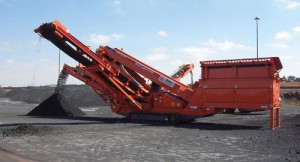
Terex Finlay 683
The mobile Terex Finlay 683 SUPER TRACK sorting plant was used to sieve (size separation) solid waste mixed with inert materials (gravel, cinders) or the ones resulting from constructions or demolitions for reclamation purposes.
The mobile waste sorting processing capacity is of 40-80 t/h;
When sorted, waste is conditioned for subsequent treatment in plants or elimination through burning, co-burning, final storage.
DOPPSTADT-type coarse fraction sorting equipment. Intergated Environment Authorization no. 117 NV6 of October 18, 2010.
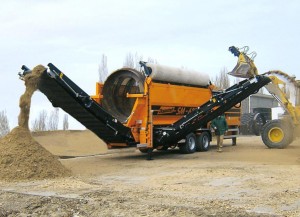
DOPPSTADT
This plant is used to treat the coarse contaminated fraction. The coarse fraction is fed into the supply tank from where the material is transported on the conveyor belt to a closed drum, with baffles. When the material enters the drum, it is circulated under a high pressure water jet, the contaminated coarse fraction and water mixture being subjected to mixing operations through the drum rotation. The last segment of the drum includes a perforated section where the cleaned material is subject to final washing under high pressure jet, and after the passage through this area, the potentially clean material is separated from the water-sludge-contaminant mixture. The potentially clean material (coarse fraction) is collected on the rear discard conveyor and stored. Polymer can be added during washing (depending on the contamination degree), which helps decontaminate this fraction.
The washing procedure is applied whenever required, until the contaminated coarse fraction complies with the parameters imposed under the laws in force, so that it can be used as filling material in less sensitive areas.
Depending on the granularity of the processed material, the output of the plant ranges between 25 and 35 t/h.
SVEDALA contaminated soil washing plant. Environmental Permit no. 326 of July 22, 2008, reviewed on September 10, 2012

Svedala
The contaminated soil treatment plant was especially designed to eliminate polluting agents such as oils, hydrocarbons, and phytosanitary products.
The plant has a decontamination capacity of 30 t contaminated soils/h.
Pursuant to the treatment operations, soil types with a humidity of 10-15% are obtained and a sludge containing the contaminants in the materials inserted in the plant, with a humidity level of 50%.
Depending on the concentration of pollutants, the resulting soil types can be:
- re-treated in the plant;
- reclaimed for construction works in less sensitive areas, provided that the observe the requirements under the laws in force;
The sludge resulting pursuant to the treatment operations, depending on pollutant concentration, can be treated as follows:
- bio-remedy – followed by reclaiming, in compliance with the provisions in the laws in force;
- elimination – bu burning/co-burning carried out by authorized companies.
The operating principle of the plant is to attract contaminated substances in a high flow of dilluted liquids containing cleaning, foaming, pH correction, and emulsion agents.
The mixture of contaminated soil and water is subjected to successive mixing, sorting, treatment, and flotation operations, to separate contaminated substances.
In the final stages, the soil and the decontaminated mineral aggregates, as well as the contaminant-containing sludge are dehydrated by sieve-type, respectively double rotativing sieve-type sorting machines. The water is recirculated in a percentage above 90%.
The equipment is made per modules, it is compact and designed to allow for transportation in the areas where treatment operations are performed.
Korte wastewater (leachate) treatment plant
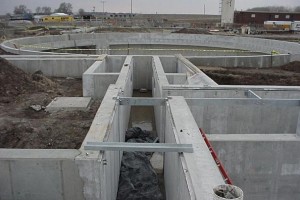
Korte wastewater plant
The plant is used to treat wastewater. When exiting the treatment plant, the wastewater is treated and the sludge is depressed, being then sent for storage or burning.
The main activities carried out as part of the industrial wastewater treatment process are:
- wastewater extraction;
- wastewater conditioning;
- liquid phase component separation through floating;
- wastewater filtering;
- dehydration of sludge in the press filter;
- compliant storage of water and of the resulting sludge.
TARMAC direct desorption plant
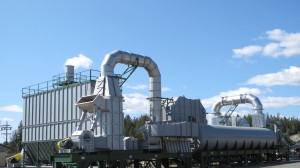
TARMAC Installation
Used to clean hydrocarbon-contaminated soils. It has an output of 25-30 tons/h. Environmental Permit no. 326 of July 22, 2008, reviewed on September 10, 2012
The thermal desorption technology includes two depollution stages:
- heating the contaminated material so that contaminant volatilize;
- treating exhaust has in order to ensure compliance with the legal provisions in force.
The material can be heated in two ways:
- indirect contact – the heat is transferred from source through a physical DTI barrier;
- direct contact of the sludge with a combustion flame and/or through DTD convection;
While indirect thermal desorption (DTI) can be applied to a wide range of soil pollutants, direct thermal desorption (DTD) is mainly used in the treatment of hydrocarbon-contaminated soils and/or other pollutants with volatile components.
The soil hydrocarbon (TPH) concentration shall not exceed 10% and humidity shall not exceed 15%. If these limits are exceeded, productivity will be considerably reduced.
Thermal desorption process stages are:
- soil conditioning for introduction into the thermal desorption plant – coarse sieving for foreign body separation (stone, roots, pieces of wood etc.), followed by drying until humidity drops below 15%;
- introduction of contaminated soil into the plant desorbent, using a conveyor and a worm, preceded by fina material sieving up to a granularity of no more than 20 mm;
- in the first stage of the process, in the desorbent, the contaminated soil comes into contact with the burning gases, at a controlled temperature ranging between 450 and 580 oC, water and toxic substance vapour in the soil;
- in the second stage, in the oxidizer, the resulting gaseous phase is heated and oxidized at temperatures of 800 – 870 oC, until the carbon dioxide or other non-hardous oxides;
- in the third process phase, the gaseous phase, which also triggered solid particles, which is cooled down to approx. 130 – 170 oC, using a water spraying system; by cooling in the washing scrubber and by passing through the centrifuge separator, this phase is separated into a non-hazardous gazeous component released into the atmosphere, which is recirculated into the oxidizer;
- the water used in the spraying system is caught, cooled, and recirculated in order to retain the dust and the condensating volatile substances, released from the contaminated soil;
- the soil decontaminated in the first phase of the process is cooled down, checked through specific laboratory analyses, and stored for re-used.
The major advantage of thermal direct desorption is the higher productivity as compared to indirect thermal desorption. This advantage is due both to the fact that the contaminated soil comes into contact with the burning gases in the desorber, and to the fact that the petroleum products in the soil facilitate burning, and improve the output of the plant.
The mobile plant – outfitted with an individual power generator – is mounted into trailer platforms, thus ensuring easy installation in areas located in the vicinity of the contaminated site and, implicitly, the substantial reduction of the contaminated soil transportation costs.
The mobile direct thermal desorption plant is equipped with all measurement and control devices required to monitor and adjust flow parameters in real time.
Mobile railway plant for the washing of the solid material resulting from railway earthworks; The plant is outfitted with a washing installation, as well as with the wastewater decontamination plant. Environment Permit no. 326 of July 22, 2008 reviewed on September 10, 2012
The mobile plant for the treatment of contaminated railway crushed stone was especially designed for the elimination of pollutants such as oils and hydrocarbons.
The following result from the treatment operations:
- crushed stone with a humidity of 10-15%, to be laid on the railroad;
- coarse sludge, containing the contaminants resulting pursuant to the washing of the stone in the equipment;
- fine sludge resulting pursuant to wastewater treatment.
Depending on pollutant concentration, the resulting sludge can be:
- treated by bio-remedy followed by reclaiming, in compliance with the laws in force;
- reclaimed for construction works in less sensitive areas, provided that the provisions in the laws in force are observed;
- eliminated through: burning, co-burning or final storage by authorized companies.
The operating principle of the plant is to attract contaminated substances in a high flow of dilluted liquids containing cleaning, foaming, pH correction, and emulsion agents.
The mixture of contaminated soil and water is subjected to successive mixing, sorting, treatment, and flotation operations, to separate contaminated substances.
The plant is mounted on a waggon platform; it is compact and designed for transportation iin areas where crushed stone treatment operations are performed.
Transport of hazardous goods and waste
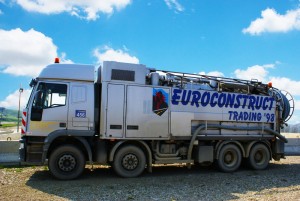
Hazardous goods and waste transport vehicle
Hazardous waste transportation vehicle
The hazardous and non-hazardous waste transportation activity is carried out under integrated management system conditions, according to SR EN ISO 9001, SR EN ISO 14001 and SR OHSAS 18001.
Our company holds a license for public road transportation of hazardous goods and waste, the transporation means, and drivers specializing in the transport of hazardous waste.
Waste is transported with the existing vehicles, according to the provisions in the GD no. 1061/2008 on the transporation of hazardous and non-hazardous waste on the territory of Romania.
Vehicles made up of tractor head and covered semi-trailer, as well as the (8×4) ones are authorized for the transportation of (packed) hazardous and non-hazardous waste. Tipping dipper vehicles ar also authorized for bulk transportation.
The company’s fleet is made up of vehicles of various capacities (1.5 tons, 3.5 tons, >7.5 tons). The type of vehicle sent in response to a takeover and transport request is selected by the column head, depending on the quantity of waste to be collected, as well as on the weight restrictions (if applicable) on the road sector where the vehicle is to circulate.
The transport routes are set as follows:
- For hazardous waste transport, they are set by the Inspectorate for Emergencies in the county where the waste holder is located and they are recorded in the hazardous waste approval form (annex 1 to GD 1061/2008). There is a main route and a secondary (bypass) one;
In the case of non-hazardous waste, the transportation route is internally set, by the column head, considering the traffic and weight limitations on public roads.